

Procuring industrial chemical equipment—whether a standalone continuous reactor, a specialized heat exchanger, or a complete white carbon black production line—is a high-stakes capital investment. A single oversight in technical specification can lead to catastrophic operational downtime, compliance failures, or premature equipment degradation.
For chemical plant operators, procurement managers, and EPC engineers, evaluating equipment goes far beyond comparing upfront capital expenditure (CAPEX). It requires a rigorous technical review of how equipment performs under specific thermodynamic, corrosive, and mechanical stress profiles.
As an established manufacturer of custom chemical machinery and complete process lines, we have compiled the core specifications every engineering team must evaluate before finalizing a procurement decision.
1. Thermodynamic & Pressure Design Limits
The primary criteria for chemical equipment selection revolve around design pressure and temperature envelope. Operating parameters must be distinguished from maximum design parameters to build a sufficient safety margin into the vessel or system.
Design vs. Operating Pressure: Equipment must be engineered to withstand transient pressure surges, exothermic runaways, and vacuum conditions without structural deformation. Ensure ASME Section VIII (or EN 13445) pressure vessel design compliance.
Thermal Cycling & Heat Transfer Efficiency: In batch reactors and crystallization systems, rapid heating and cooling cycles induce thermal fatigue. Evaluate the heat transfer area, jacket design (dimple, half-pipe coil, or conventional jacket), and thermal conductivity of internal alloys.
Insulation & Heat Loss Prevention: Thermal efficiency directly impacts operating expenses (OPEX). High-temperature processing equipment requires integrated insulation jacketing and thermal barrier considerations.
2. Metallurgy & Material Science Compatibility
Chemical corrosion is a primary driver of equipment failure. Selecting the correct metallurgy requires understanding the exact fluid chemistry, including trace impurities, pH fluctuations, and flow velocity.
Corrosion Resistance: Standard austenitic stainless steels (304/316L) suffice for mild media. However, high-chloride, acidic, or highly oxidative environments demand duplex stainless steels, nickel-based superalloys (such as Hastelloy C-276), or reactive metals (Titanium, Tantalum).
Erosion-Corrosion Synergy: In processes involving solid slurries or precipitation—such as silicide processing or precipitating silica—high fluid velocities erode protective oxide layers on metal surfaces. Alloys with higher hardness or specialized internal linings are required.
Surface Finish & Cleanability: Internal surface roughness ($R_a$ values) affects polymer build-up, fouling rates, and cleaning efficiency (CIP/SIP). Mechanical polishing or electropolishing down to $R_a < 0.4\,\mu\text{m}$ is critical for sticky or high-purity chemical reactions.
3. Mechanical & Structural Rigidity
A chemical processing system must withstand continuous dynamic forces generated by agitation, pumping, and fluid flow.
Structural Component | Critical Engineering Specifications | Operational Impact |
Agitator & Drive Assembly | Impeller design (pitched blade, hydrofoil, anchor), torque rating, variable speed control (VFD) | Determines mixing efficiency, gas dispersion, and suspension of solid particles |
Mechanical Seals | Single vs. double mechanical seals, barrier fluid compatibility, API flush plans (e.g., Plan 53B) | Prevents hazardous vapor leaks, contamination, and toxic emissions |
Vessel Wall Thickness | Corrosion allowance calculation, shell & head structural integrity under full vacuum | Ensures structural safety and extends design service life (10–20+ years) |
4. Automation, Control Integration, and Process Safety
Modern chemical plants operate with a high degree of automation to ensure process repeatability, product quality, and workplace safety.
Instrument Integration: Check if the equipment is outfitted with high-accuracy, explosion-proof sensors for temperature, pressure, level, and flow measurement (supporting HART, Modbus, or PROFIBUS protocols).
Safety Interlocks & Relief Systems: Pressure relief valves (PRVs), rupture discs, and emergency shutdown (ESD) interlocks must be seamlessly integrated into the process control architecture (PLC/DCS).
Hazardous Area Compliance: Electrical components, motors, and instrumentation must meet regional explosion-proof standards such as ATEX, IECEx, or Class I, Div 1/2 requirements depending on the plant environment.
5. Complete Line Integration & Manufacturer Capabilities
When purchasing complex production units—such as complete white carbon black processing systems—individual machine specifications are only part of the equation. Interconnectivity and line balance determine overall plant efficiency.
Turnkey Engineering & Modular Design: Evaluate whether the manufacturer provides modular skid-mounted solutions that reduce on-site civil works and installation timelines.
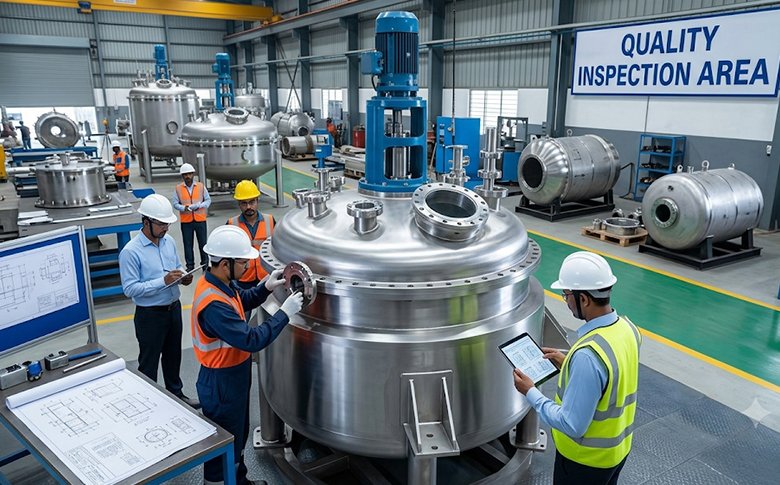
Quality Assurance & Testing (FAT/SAT): Insist on rigorous Factory Acceptance Testing (FAT) including hydrostatic testing, non-destructive testing (NDT) like X-ray or dye penetrant inspection of welds, and dimensional verification prior to shipment.
Lifecycle Support & Spare Parts Provisioning: Inquire about critical spare parts availability, remote technical support, and long-term maintenance service agreements.
Conclusion
Purchasing industrial chemical equipment is an exercise in balancing performance, safety, and long-term operating costs. By systematically auditing thermodynamic boundaries, metallurgy, mechanical design, automation, and testing protocols, engineering teams can secure equipment that delivers maximum uptime and ROI.
Looking to upgrade your chemical processing line or configure custom pressure vessels? Contact our technical engineering team to review your process parameters and receive a tailored design proposal.