

Selecting the appropriate material for a chemical reactor is not merely a purchasing decision; it is a critical engineering calculation that determines the entire life cycle, safety, and profitability of a chemical production facility. In high-corrosion environments, the stakes are exponentially higher. A single material failure can lead to catastrophic leakage, unscheduled shutdowns costing millions, and severe safety hazards.
As a leading manufacturer of specialized chemical equipment, we understand that "one size fits all" is a dangerous philosophy. This article provides a structured, technical framework for engineers and project managers to navigate the complex matrix of material selection for corrosive reactor environments.
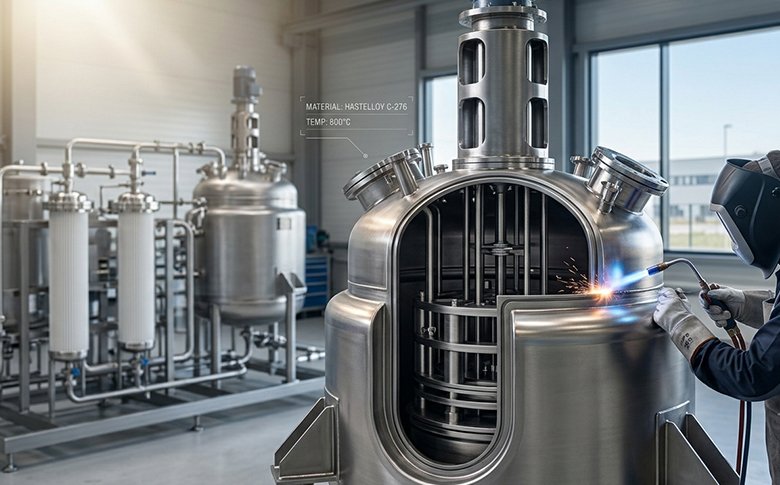
1. The Corrosive Environment: Defining the Challenge
Before a material can be selected, the environment must be rigorously defined. High corrosion is rarely caused by a single factor. It is usually the synergy of several variables.
Chemical Compatibility and Concentration
The primary corrosive agent (e.g., sulfuric acid, hydrochloric acid, nitric acid, caustic sodas) must be identified. However, the concentration is equally critical. For instance, some stainless steels exhibit excellent resistance to dilute sulfuric acid but fail rapidly in concentrated solutions, or vice-versa. Trace impurities can also act as powerful catalysts for corrosion, significantly altering the material's performance.
Operating Temperature and Pressure
Corrosion is a kinetic process, and its rate generally increases with temperature. A material suitable at ambient temperature may be completely utterly inadequate at 200°C. High pressure adds mechanical stress, making materials more susceptible to specific failure modes like Stress Corrosion Cracking (SCC).
Flow Dynamics and Erosion
In reactors, fluid velocity, agitation, and the presence of solids (slurry) introduce a mechanical wear component. Erosion-corrosion occurs when the turbulent flow removes the protective passive layer of a metal, exposing fresh surface to chemical attack. Processes like the production of White Carbon Black, which involve solid precipitation and handling, demand reactor materials that can withstand both chemical attack and physical abrasion.
2. Advanced Material Solutions: A Comparative Overview
Chemical equipment manufacturers utilize a spectrum of materials, each occupying a specific niche based on cost-performance.
Highly Alloyed Stainless Steels (e.g., 316L, Duplex, Super Duplex)
Stainless steels are the workhorse of the industry for mild to moderate corrosion. 316L, with its molybdenum addition, offers decent pitting resistance. Duplex stainless steels (like 2205) provide nearly twice the yield strength and enhanced SCC resistance, making them ideal for high-pressure, high-chloride environments.
Nickel-Based Superalloys (e.g., Hastelloy, Inconel, Monel)
When stainless steel fails, nickel alloys step in. Hastelloy C-276, for example, is arguably the most versatile corrosion-resistant alloy available, maintaining stability in both oxidizing and reducing media, including wet chlorine and ferric chloride. Monel is specific for hydrofluoric acid applications. The primary drawback is significantly higher material and fabrication costs.
Reactive Metals (e.g., Titanium, Tantalum, Zirconium)
These metals rely on the formation of an exceptionally stable, tenacious oxide surface film.
Titanium: Excellent in oxidizing environments, nitric acid, and seawater, but attacked by reducing acids (like HCl).
Tantalum: The ultimate "inert" metal, resistant to almost all acids (except HF) even at high temperatures, often used as a liner for critical reactor components.
Non-Metallic Solutions: Glass-Lined Steel and PTFE Linings
Glass-lined reactors combine the mechanical strength of steel with the near-universal corrosion resistance of borosilicate glass. They are excellent for strong acids and high purity products, provided they are protected from thermal shock and high alkalinity. Fluoropolymers like PTFE (Teflon) offer universal chemical inertness but have temperature and pressure limitations compared to metals.
3. Systematic Approach to Material Selection (MFA)
To ensure the most robust and cost-effective selection, engineers should follow a simplified Material Failure Analysis (MFA) approach:
Selection Stage | Critical Questions to Answer | Data Required |
I. Process Mapping | What are the absolute max/min conditions? Any trace impurities? | Full Chemical Composition, Process Flow Diagram (PFD) |
II. Screening | Which material families are chemically incompatible? | Corrosion Tables, Isocorrosion Diagrams |
III. Optimization | What is the expected equipment lifespan vs. total lifecycle cost? | Lab/Pilot Plant Corrosion Testing Data |
IV. Mechanical Validation | Can the material withstand the required pressure and agitation? | ASME Section VIII, Material Strength Data |
V. Fabrication | Can this material be reliably welded, formed, and inspected? | Manufacturing Facility Capabilities, NDT methods |
4. The Manufacturer's Role: Expertise Beyond Material Data
While corrosion charts provide a baseline, a successful high-corrosion reactor project requires close collaboration with your chemical equipment manufacturer. A manufacturer with deep experience in integrated production lines—similar to the complex engineering demanded in White Carbon Black complete equipment—offers value that generic material data sheets cannot:
Understanding Scale-Up: Corrosion behavior in a 1-liter laboratory autoclave often differs significantly from a 50,000-liter production reactor due to mixing gradients and heat transfer profiles.
Advanced Welding Techniques: Reactive metals and superalloys require precise, controlled welding environments (e.g., argon shielding) to prevent contamination, which embrittles the material and causes premature failure at the seams.
Custom Geometric Design: Effective design can minimize turbulent zones and stagnation areas where erosion-corrosion or crevice corrosion typically initiate.
Conclusion
Choosing the right reactor material for high-corrosion processes is a balance of chemistry, thermodynamics, and economics. While the upfront cost of advanced alloys or reactive metals might seem high, they are often the most economical choice over the lifecycle when the cost of downtime, maintenance, and replacement is considered. Partnering with a manufacturer who understands this complexity transforms a capital purchase into a strategic asset.
To discuss your specific corrosive environment and explore custom reactor solutions, please contact our engineering team.